I’ve spent a few Christmases with this girl, she is a great communicator!



Reminding me it was going to be breakfast time soon!

Resources
(& my philosophy, briefly)
Here are some of the books, papers, and educational resources that have been very valuable in shaping my understanding of animal behavior, communication, welfare, learning, and cognition.
While many of these resources focus on dogs, the underlying principles extend far beyond any one species. They emphasize respecting each individual's bodily autonomy and agency, learning to recognize and respect each individual's unique communication style rather than expecting them to communicate the exact same way we do, and, in general, supporting them in the ways that work best for them rather than in the ways we think they should be supported.
These resources have also helped me better understand the importance of looking at myself as the first step toward supporting anyone else, and how trauma, stress, fear, and lived experience shape all of our lives.
I'd love to hear about any books, research, experiences, or life lessons that have shaped your own approach to interacting with animals, or to discuss any of the principles of animal care that matter most to you!
Communication, Behavior & Body Language
Abrantes, Roger. Dog Language: An Encyclopedia of Canine Behavior.
A comprehensive reference on canine behavior, communication, and ethology.
Chin, Lili. Doggie Language: A Dog Lover's Guide to Understanding Your Best Friend.
An clear, beautifully illustrated guide to canine body language- this could be a good one to share with younger family members. Covers common body language signals and as the title suggests, helps you learn to recognize what your dog may be trying to convey.
Milani, Myrna M. The Body Language and Emotion of Dogs: A Practical Guide to the Physical and Behavioral Displays Owners and Dogs Exchange—and How to Use Them to Create a Lasting Bond.
Explores the relationship between canine body language, emotional states, and human–dog interactions.
Rugaas, Turid. On Talking Terms with Dogs: Calming Signals.
The classic introduction to canine calming signals and subtle forms of canine communication. Rugaas is a brilliant trainer who also wrote the book below, I recommend any of her books.
Rugaas, Turid. Barking: The Sound of a Language.
Examines barking as a meaningful form of canine communication rather than simply an undesirable behavior.
Barnett, S. A. The Rat: A Study in Behavior.
A classic scientific work exploring the natural behavior, social organization, learning, and ecology of rats.
Fear, Trauma, Welfare & Emotional Well-Being
Becker, Marty, DVM, and Mikkel Becker, CTC. From Fearful to Fear Free: A Positive Program to Free Your Dog from Anxiety, Fears, and Phobias.
An evidence-based approach to reducing fear, anxiety, and phobias using positive, low-stress training techniques. I have a certification in “Fear-Free Pet Care”, which is a training program increasingly required for all working with animals, from shelter workers to veterinarians to foster parents.
Buffington, C. A. Tony, DVM, MS, PhD. Decoding Your Cat.
Written by veterinary behaviorists, this book explores feline stress, behavior problems, environmental needs, and emotional welfare using an evidence-based approach.
Marino, Lori, PhD. Thinking Chickens: A Review of Cognition, Emotion, and Behavior in Domestic Chickens.
Although published as a scientific review rather than a book, this landmark paper synthesizes decades of research demonstrating that chickens possess sophisticated cognition, emotional lives, distinct personalities, complex social relationships, and impressive learning abilities. It fundamentally challenges the misconception that chickens are "simple" animals and has become one of the foundational works in modern poultry cognition and welfare science.
Bekoff, Marc, PhD. The Emotional Lives of Animals.
A thoughtful exploration of animal emotions, empathy, cognition, and welfare across species, drawing from decades of behavioral research.
Safina, Carl. Beyond Words: What Animals Think and Feel.
Examines animal cognition, emotion, consciousness, and social lives through scientific research and firsthand observation.
Spaulding, Kristina. The Stress Factor in Dogs: Unlocking Resiliency and Enhancing Well-Being.
A thorough examination of canine stress physiology, trauma, resilience, and long-term emotional health.
Enrichment, Agency & Cooperative Care
Bender, Allie, CDBC, CPDT-KA, SBA, and Emily Strong, CDBC. Canine Enrichment for the Real World.
One of the most influential modern books on animal welfare and enrichment. Rather than viewing enrichment as simply providing toys or puzzles, the authors present a framework centered on meeting each individual's behavioral, emotional, and biological needs. Emphasizes agency, choice, predictability, and species-appropriate opportunities that promote resilience and overall well-being.
Jones, Deborah, PhD. Cooperative Care: Seven Steps to Stress-Free Husbandry.
The foundational text on consent-based handling and cooperative care. Topics include supporting animals to voluntarily participate in husbandry procedures, recognizing and respecting withdrawal of consent, building trust through choice rather than restraint or coercion, and low-stress veterinary care, grooming, and other routine procedures.
Learning Theory & Behavior Science
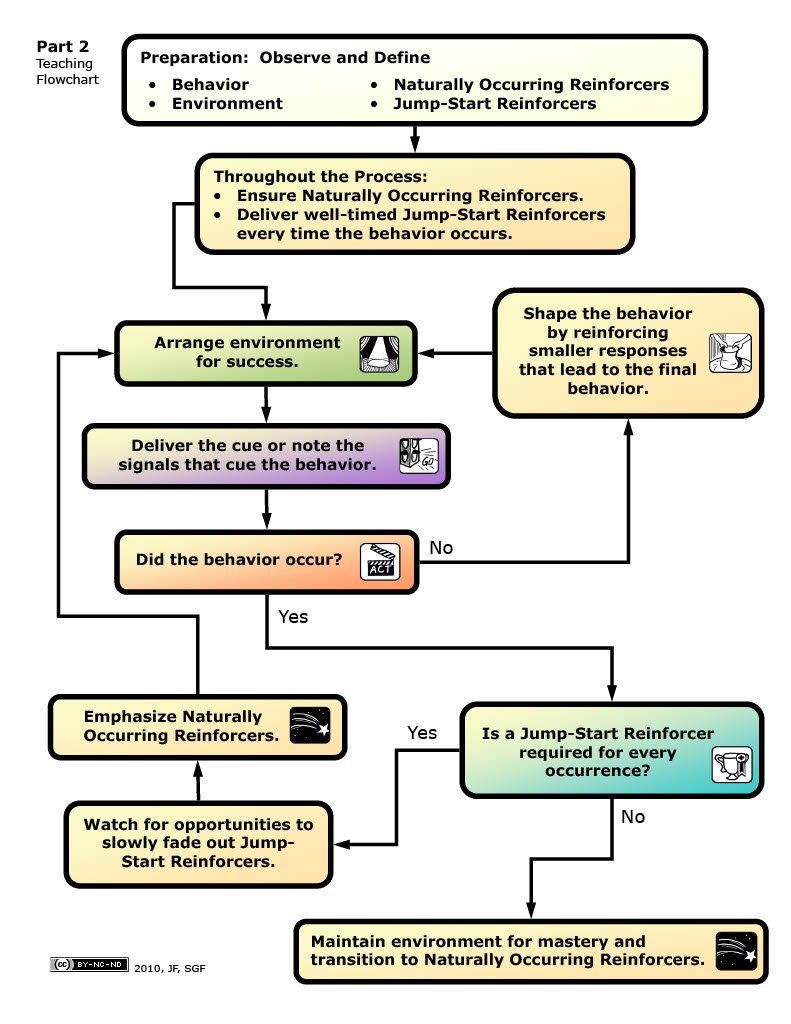
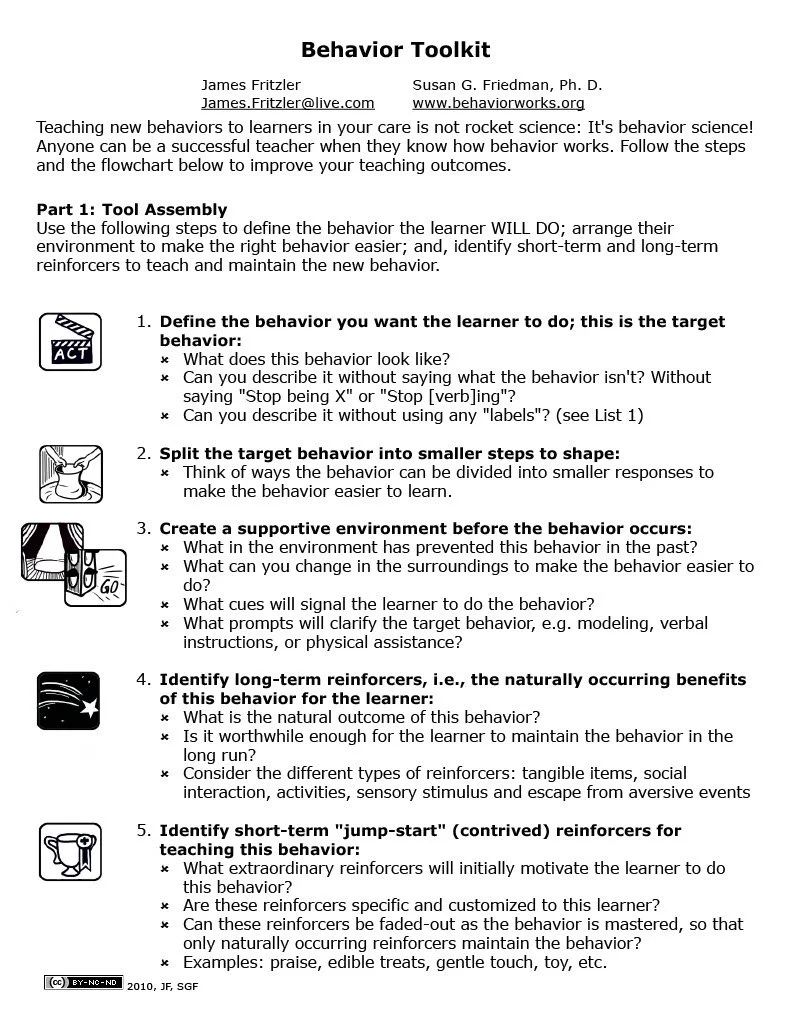
Friedman, Susan G., PhD. Behavior Works- https://www.behaviorworks.org.
Her “behavioral toolkit” is pasted below- it’s a great starting point with her work, and I especially appreciate the third part, her “list #1”.
Although Dr. Susan Friedman has not published a book, she is one of the most influential figures in modern applied behavior analysis. While much of her work originated in companion parrots, the principles of learning, reinforcement, motivation, antecedent arrangement, and behavior change apply broadly across species—including dogs, cats, birds, reptiles, rabbits, rodents, and humans.
Additional articles, lectures, and educational materials are available through the Behavior Works website.
McConnell, Patricia, PhD. The Other End of the Leash: Why We Do What We Do Around Dogs.
Examines how normal human behavior influences canine behavior and communication.
Yin, Sophia, DVM, MS. How to Behave So Your Dog Behaves.
A popular introduction to learning theory, behavior modification, and evidence-based dog training. Yin was a wonderful behaviorist who cared deeply about animals and wrote a lot of outstanding books.